Wednesday, March 1, 2023

2023 - March - I not I ?

 Over the years, I've addressed aspects of POV-Viewpoint, which are two different things. POV is the who and Viewpoint is the how of a narrator telling the story. This month, let's look at an aspect of the "I" narrator.

Some writers think using the first person "I" narration is better than the other POV-Viewpoint techniques. Trouble is, new writers inadvertently confuse who the "I" narrator really is because there can be two different "I" personalities on the page.

The first "I" is the writer. The second "I" is the story's narrator. When the writer hits the page, it usually becomes an Author Intrusion—which is to be avoided because readers hate them. There are different types of Author Intrusions. The blatant ones go something like, "little did she know what awaited her tomorrow."

Anther blatant type is to get historic facts wrong, like a writer stating Genghis Khan as a ruler when the story was set years after his death and the correct name should have been Kublai Khan.

The more subtle Author Intrusions are harder to locate. These include characters not acting like they should. An example would be a drugged victim speaking with clarity or a street-wise kid spouting Ivy-league words or using their diction or syntax are those of the writer.

The worst kind of Author Intrusion is the writer turning a character into their personal crusader. Yes, a character can be profoundly prejudicial, bigoted, and on a crusade of their own. When the writer steps in and takes over the narrative from the character to expound on a virtue or vice dear to the author's heart, that's what will turn off the reader.

So, is there a way to spot or avoid Author Intrusions and catch those substitutions of the I of the narrator versus the I of the writer? Here are two:

1) Do not edit as you write. Once a draft is done, let it set, step away from the story and characters. Come back to the draft and listen for the voice of the narrator coming off the page. Does it sound like the character or is it different—like the writer's voice? Of course, all depends on the writer's ability to hear the voices coming off the page and to distinguish their own voice from the characters.

2) Know your characters. Some writers use character sketches, character questionnaires, character worksheet on which to delve deep into their characters back story, their personalities, likes, dislikes, prejudices, their moral fiber, their mannerisms, their speech patterns, their motivations, and more. Other writers draft text and, in the revision process, they self-edit. They may also depend on critique partners or groups and beta readers to spot and fix Author Intrusions.


# # # 


Wednesday, February 1, 2023

2023 - February - How-To Books


How-To Books 

If you're writing for yourself, no one will see or care how you write or use words or string sentences along. It's when the goal is to write a story that someone else will rave about or pay money for that the writer must look at what story is and how the patterns of prose and story engage the mind of another person.

The secret to a great story is that they are written and ruthlessly edited so that the words create a movie in the reader's mind.

There's nothing new about the craft of storytelling or the patterns of plot. To write quality stories requires learning those worthwhile story techniques and devices that have been handed down for centuries.

Every day writers go online and read blogs or listen to podcasts on the various aspects of writing. Trouble is, those are only quickie overviews. If a writer is serious about learning to write well and tell a story well, they invariable turn to the proven how-to books that teach a technique, device, or aspect of fiction or nonfiction.

I always advocate that a writer who wants the low-down on a particular aspect of storytelling to get at least three books on the subject, read each, take notes, study examples, and do any exercises those books recommend. And, no, I do not advocate buying the books. I recommend borrowing them from a local library. If one or all three (or more) books prove valuable, then spend the money to own the book and make it your bible. After all, such a book's author is your writing mentor.

I've said it before and I'll say it again—talent will take a writer only so far, it is craft that enhances talent and liberates creativity. Check out the shelves of your local library and consider using the Library Loan System to advantage and write the stories of your heart.


P.S. If you need a book recommendation on a technique or device, let me know.


# # # 


Sunday, January 8, 2023

2023 - January - Looking back, Looking Forward


I began this Writers Cheat Sheet Blog fifteen years ago. That's a lot of years, a lot of blog posts, and a helluva lot of words committed to the subject of writing well and telling a story well.

Fifteen years ago, writers were keen to learn the craft of telling good stories and writing using proven techniques for engaging the reader. They waited until they masters the techniques and devices of storytelling.

Not so since Amazon.com and the digital age of self-publishing-and-get-rich. The Internet abounds with quickie information on how to write the novel or short story, fiction or nonfiction, and be an author–and do it in thirty days or even ten weeks. Truth is, it takes years to achieve quality writing and quality storytelling because there is so much to learn about story, about characterizations, about plot.

Yes, templates and computer programs abound to make the story writing quick and simple. But writing is not simple. Telling a story that another person can see as a movie in their mind isn't easy— it's downright hard. 

Getting a story seen is ten times more difficult in today's ultra-flooded marketplace. It's still true now as back in 2007— it seems everyone thinks they can write The Great American Novel. And they write one and self-publish. 

I'm not down on the self-publishing, just on the glut of poor quality and draft reads that are out there. Over the holidays, I spent hours looking for a book to read and finding none I could read from beginning to end. Most I stopped after the first chapter. One I was 60% through when the plot went off on a tangent.

Of course, writing successful, marketable stories takes time and know-how. It requires a commitment to learn craft, to strive to write well and to strive to tell a story well. It's climbing the ladder one rung at a time. There are no swift elevators to the top or to success.

So, as the new year gets underway, it's that time of year to set down, in writing, the New Year's Resolutions. After all, as your desire is, so should be your deed. 

Why write down goals? Because writing the down, committing them to paper is a commitment to giving the writing priority. Writing down goals is one big step in making goals concrete. Writing down goals becomes a contract with the subconscious that shouts "I INTEND TO SUCCEED."

As you aspire to become the author you plan to become, what goals will you strive for that are realistic and achievable in 2023? 


* * *

Thursday, December 1, 2022

2022 December - The 12 Days of Christmas


As is often the case, math turns out not to be a writer's strong suit. That's because words are (or should be) a writer's forte. 

So, just for fun, I'm deviating from a writing topic to boggle your mind with this question:

Just how many gifts did "My True Love" give? 

Or sate your curiosity with this question:

How much did all the gifts cost, either individually or as a total. 

Being a writer, you could use either question as a writing prompt by taking one POV-Viewpoint (i.e., be the giver or the receiver or the person fulfilling the order, etc). If you come up with something under 200 words, feel free to share it in the comments section below. Write short in any genre or in any style. See where your imagination leads you.

However, if you just want the facts, the mathematical input and total, go to

https://www.houseofmaths.co.uk/2016/12/how-many-gifts-in-total-in-the-twelve-days-of-christmas/

or 

https://www.cnn.com/2022/11/17/economy/12-days-christmas-cpi-inflation

In any event, I wish you all the Happiest of Holidays!

Catherine E. McLean

# # # 

Wednesday, November 2, 2022

2022 November - The Anchoring of Time and Place

Writers are admonished to "anchor the reader in a time and place" when opening a story. The best way, of course, is to weave in clues or provide tidbits that vividly or subtlety describe the setting, era, or time of day or night without stopping the action. For example:

Lady Eleanor Black sidled into the midnight shadows of vines that clung to the stone edifice of Covenant Gardens.

In this example, there is a particular character (Lady Eleanor Black) doing something interesting (sidling into shadows) and who is at a particular place (Covenant Gardens). The clues are there that indicate this is nighttime and it's Regency England. Of course, the reader of such historicals becomes curious as to why Lady Black is hiding behind the vines and so the reader continues to read.

Sometimes— and to be used only when all else fails— a writer might resort to using the point-blank method of a subheader before the story's opening paragraph, like:

Regency London

Lady Eleanor Black sidled into the midnight shadows of vines that clung to the stone edifice of Covenant Gardens.


Another method of opening a story is with intriguing dialogue, like this from one of my medieval WIPs:

"Are you not afraid, Good Woman, being out here by thyself?"  Mallory shifted his cloak and sat upon the stump where she had bade him. Overhead the trees stood silent, for no evening breeze trespassed in the King's wood.


And there is always the tried and true method of starting in action, like:

A shrill whistle blew with sufficient intensity to gain the attention of the small group of colony's miners yelling both profanity and encouragement to the two men tangled in hand to hand combat in the center of their circle. 

Yet, far too often writers open with a description of the setting, like this:

On the horizon, swiftly barreling down the valley between the high peaks, came black thunder clouds. Pitchforks of lightning flashed from sky to ground but were replaced by a deluge of rain. The creeks and gullies soon filled with water, gushing and racing to empty into the nearby creeks, the creeks into the river--a river swollen from a week of rain--and all of that water emptying into the dam basin. The water there was now well over flood stage. 


Why is this a poor opening? The three reasons why are: 

1) nothing is really happening

2) no character or person is involved

3) there is no distinct and opinionated POV-Viewpoint

Read the paragraph again. Notice that a picture is painted of scenery as if it's a report. This is also viewpointless narration, which brings me to reason number two—no specific character or person is involved in action. If a person were involved, this opening might become:

My gaze riveted on the horizon where thunder clouds swiftly barreled down the valley between the high peaks. I scrambled up the rocky path to higher ground, cursing myself for deciding to hike to the caves to find silent sanctuary and sort out my husband's newly confessed infidelity. Now I was going to get soaked for my impulsive impulse to run and hide until the hurt eased. My life couldn't get any worse.
Pitchforks of lightning flashed from sky to ground.
I paused to watch the display, then shifted my gaze to a wall of rain coming down from the blackest of clouds, drenching the rugged slope of The Iron Face.
Flash flood!  Flash flood! echoed in my mind.
Huge raindrops pelted my back, soaking through my denim jacket.
I had to get to safety.

The character POV-Viewpoint version is also an example of showing, not telling, because everything is filtered by a distinct, opinionated POV-Viewpoint of a woman narrator.

Take a look at your most recent WIP (Work In Progress). Which method of anchoring your reader in a time and place did you use for your opening? If not one of the above mentioned types, what did you open your story with?

# # # 

Saturday, October 1, 2022

2022 - October - Wicked Words

Red Flag Words & Phrases

Writers have crutch phases and crutch words they use when drafting. These are habit words, that is, words that are placed on the page without consciously thinking about them being overused words.

When critique partners point out such overused words or phrases, start a Red Flag List of them and ruthlessly remove them when you self-edit. 

But go an extra mile— once aware of such Red Flag Words, start to eradicate typing them or using them as you draft. It's best to do one Red Flag word or phrase at a time. After all, you can't catch every one all at once, right?

Okay, so once you achieve success with one Red Flag word or phrase minimized (yes, minimized, because sometimes it might just be the right word to leave on the page!), move on to the next word on your list.

If you're curious about what are the most wicked Red Flag Words, they are: WAS and its companion WERE. Next is AND, BUT, JUST, SO, ONLY. 

How can you figure out if you have such Red Flag Words in such quantities that its detrimental to the manuscript? Here's how:

Take ten pages of your writing, any ten. Use your computer's search and find feature and look for WAS. If your word processor highlights in color, look at the pages—are they dotted with highlights or does the highlight appear in clusters? In both instances, can you cut down on the number by providing better, image-provoking verbs? 

Now, is also a good time to get your computer to tell you how many WASes is in your sample. Divide the number of WASes into the number of words. What is the ratio? Strive for a ratio of one WAS per page (or one in 331 words).

For the record, when I had writers do this exercise in my online courses, one writer discovered she used was once every 15 words—in other words, in every sentence (the average sentence is 20 words). She even had two wases in one sentence.

As for me, when I began checking my work, I was lucky to get one was in 441 words. Ten years later, the average was one in a thousand. My current work in progress has a chapter that I found only one was in 3,544 words.

Keep in mind that nothing is written in stone. Some of those WASes will have to remain. Also keep in mind that the overuse of Red Flag Words at some point will drone like angry bees in a reader's mind,and the reader will either quit reading or not feel the story is worth a five-star review, let alone tell others about the story.

If you do a WAS ratio, let me know your score.

**** 

Monday, September 5, 2022

2022 - September - Color Revelations for Characters


A lot goes on in a reader's subconscious mind, as well as the writer's. In that basement (or attic) of the writer's mind are feelings and impressions garnered over a lifetime of experience in the real world. Especially buried are clues to characters that are based on real people as well as the fictional characters a writer has encountered while watching TV, videos, movies, and reading. As to reading, that includes stories as well as what's been read in newspapers, magazines, and advertisements.

Yes, advertisements. Take for example the perfume and cologne ads. On the page is that suavely handsome man or movie-star gorgeous femme fatal. What caught your eye about them that you paused to look at the ad—and in particular the male or female in that ad?

Nine times out of ten, it's the hair color or the eye color, which includes the makeup around the eyes that enhanced them. When a writer describes their characters or jots down the initial character data on a character, chances are hair and eye color will be among the first "descriptions."  

But what the writer may not be aware of is that in those hair and eye colors are clues to the character's character. For example, why did Scarlet O'Hara have emerald-green eyes? Answer: that specific color represented jealousy and envy.

When it comes to hair color, a writer should ask: why that particular color? Several years ago, in my characterization session from my The Project Bible Course, students had to submit a short description of their protagonist and antagonist. One student filled out the "Hair Color" line with: red hair and stated "all witches have red hair." I replied that was an ad hoc fallacy—not every witch had red hair. I also pointed out that red hair ranged from palest strawberry blond of angels to the darkest down-to-earthiness of mahogany. In the middle of that wide range of color was the carroty-red and fiery-reds.  

On a subconscious level, carroty-red implies zaniness and fiery-red implies a quick temper. Does that mean good witches have blond hair or dark brown hair? Not necessarily. What it does mean is that the writer's subconscious chose that color for a reason and it's up to the writer's logical mind to decipher "why that particular color" in order to better understand the character and help the reader like or dislike the character. 

Where did I originally find out about hair and eye coloring influencing personality? From a study done on traits people perceived that went along with hair color. (It pays to read eclectically.) 

So, you're thinking, what about dyed hair? Then ask: What color of dyed hair? Then ask why that character chose that particular shade and what does that mean. Also ask the character: "What do you dislike about your own hair color that you feel you need to dye it?"

Go to your work in progress, or a story you've written and if you gave your major characters eye and hair colors, list them. What do the colors imply about each of the characters? Did they match the characteristics that went with the character? Let me know what happened by leaving a comment.

****


Monday, August 1, 2022

2022 August - Having A Project Bible


For a writer, having a Project Bible for their story writing is a means to sorting through ideas, characters, and plot points to verify there is a story with a beginning, a middle, and an ending worth the time to invest in writing it.

Basically a Project Bible is a plan of action a writer creates and uses for themselves. No two Project Bibles are alike because of each writer is unique in the way they tell a story. Project Bibles range from hard-copy, 3-ring notebooks and others are a series of master computer files.

Some Project Bibles are even as simple as 3x5 index cards that contain reminders such as the basic questions to evaluate a character:

First Name - (How is the name spelled and what subconscious reaction will the reader infer from the spelling or look of the work. That is, is the name positive/heroic, negative/villainous, or neutral/too ordinary to be a major character? What does the name mean?)

Middle Name - (Why that name? Is it positive, negative, or neutral? Does the name have a meaning?)

Last Name - (Is there a nationality associated with the name or does the name have a particular meaning—positive, negative, or neutral—associated with it?)

Initials (Initials must not inadvertently spell anything derogatory—the exception is for humor or irony.)

Nickname - (Not all characters have nicknames, but why that nickname? How did they come by it? How does the character feel about the nickname?

Another card might be for:

Body type - (How does their build help or hinder them in seeking their life's goal or the story goal or suit their occupation?)

Hair color - (Why that specific color? What traits does the color represent—or on a subconscious level, what does the color telegraph to the reader?)

Eye color - (Why that specific color? What does the color represent—or on a subconscious level, what does the color telegraph to the reader?)

. . . and the questions go on.

Some Project Bibles include very specific items like full character questionnaires, time-line calendars, maps, research material, short cuts to tags and traits, shortcuts to getting at a character's core values and morals, plot diagrams or questions on plotting (such as the Hero's Journey), collected worksheets garnered from the writer attending workshops and conference classes, and much more.

Regardless of its size or type, a Project Bible can truly minimize the frustration of dead-ends and stories that go off on a tangent.

****************************


Friday, July 1, 2022

2022 - July - The Long and Short of It


Quickly jot down your answers to these questions:


1. What is the average word length of a sentence?

2. A long sentence exceeds how many words?

3. What is the average number of sentences for a paragraph?

Here are the answers— 

1. 20 — The average word length of a sentence is considered twenty words, which is the exact word count for this sentence.

Why use such a benchmark for sentence length? Because twenty words can be said in one breath? Yes, that's true, but equally as important is that shorter sentences promote clarity (and as I've said many times— clarity trumps all rules.)

When writing fiction, it is the narrative voice (i.e., how a character or narrator thinks and talks) that the reader hears as they read. Does that narrator consistently speak and think in short, medium, or long sentences? Does that narrator consistently use simple sentence constructions or complicated or clause-filled sentences? Also, how complex is the narrator's language, diction, and syntax? Such things affect sentence lengths and brings characters to life on the page, making readers like them or hate them or feel neutral toward them.

Here's the thing: in fiction, a sentence can stand alone as a paragraph and a sentence can be as short as one word.

2. 30 to 40 — A long sentence is considered thirty to forty words. Exceed those thirty or forty words and clarity becomes an issue. So does running out of breath when speaking such sentences out loud. For the record, in READING LIKE A WRITER by Francine Prose, there is a 181 word sentence. By the way, no semicolons were used in that very clear-to-understand sentence. That sentence is broken apart by eight commas, one pair of dashes, and ends with one period. Those pieces of punctuation and the rhythm of the words allows for clarity and comprehension. It takes a pro to write with such clarity and comprehension at such a long length.

3. 3 — The average number of sentences for a paragraph is considered three (which translates to an average of sixty words.) However, all depends on the topic of that paragraph. After all, the supporting sentences to that opening line (i.e. the topic sentence) can range from three to five to eight. However, at twelve sentences, such a paragraph looks like wall-to-wall-words.

     Wall-to-wall words is a term used to describe blocks of type. When a reader comes to such a block, most readers think the subject matter is boring or too technical and they skip down to dialogue or the indentations to shorter paragraphs.

Here's a tip— any double-spaced manuscript page with four or fewer indented paragraphs should be looked at to see what's in those paragraphs. Those long paragraphs likely need broken apart for clarity. (For single-spaced pages, look for eight or fewer paragraphs.)


Take a few minutes today and go to your work in progress. Use your word processing program's zoom feature, reduce the pages to 50%. Count the white-space of paragraph indentations on each page. Also check for paragraphs that carry over to the next page. Do you have any wall-to-wall paragraphs?  

In those long paragraphs, did you find long sentences, semicolons joining clauses or sentences, or conjunctions like and joining sentences, or even run-on sentences?

Please share your findings with a comment to this blog.

Wishing you a safe and happy 4th of July celebration.

# # # 

                 Get the low-down on semicolons in Catherine's guidebook REVISION IS A PROCESS

`````````````````````````````````````````````````````````````````````````````````````````````````````````````````````

Wednesday, June 1, 2022

2022 June - The Long and Short of It


Quickly jot down your answers to these questions:

1. What is the average word length of a sentence?

2. A long sentence exceeds how many words?

3. What is the average number of sentences for a paragraph?

Here are the answers— 

1. 20 — The average word length of a sentence is considered twenty words, which is the exact word count for this sentence.

Why use such a benchmark as sentence length? Because twenty words can be said in one breath? Yes, that's true, but equally as important is that shorter sentences promote clarity (and as I've said many times: clarity trumps all rules.)

However, when writing fiction, what will affect the length of sentences is narrative voice. How does the character or narrator think and talk? Do they speak or think in short, medium, or long sentences? Do they use simple sentence constructions or complicated or clause-filled sentences? How complex is the narrator's language, diction, and syntax? Such things affect sentence lengths and bring characters to life on the page, making readers like them or hate them or feel neutral toward them.

Here's the thing: a sentence can stand alone as a paragraph and a sentence can be as short as one word.

2. 30 to 40 — A long sentence is considered thirty to forty words. Exceed those thirty or forty words and clarity becomes an issue. So does running out of breath when speaking such sentences out loud. For the record, in READING LIKE A WRITER by Francine Prose, there is a 181 word sentence. Interestingly, no semicolons were used in that sentence. That sentence is broken apart by eight commas, one pair of dashes, and ends with one period. Those pieces of punctuation and the rhythm of the words allows for clarity and comprehension. It takes a pro to write with such clarity and comprehension at such a long length.

3. 3 — The average number of sentences for a paragraph is considered three (which translates to an average of sixty words.) However, all depends on the topic of that paragraph. After all, the supporting sentences to that opening line (i.e. the topic sentence) can range from three to five to eight but at twelve sentences, such a paragraph looks like wall-to-wall-words.

     Wall-to-wall words is a term used to describe blocks of type. When a reader comes to such a block, most readers think the subject matter is boring or too technical and they'll skip down to dialogue or the indentations to shorter paragraphs.

Here's a tip: any double-spaced manuscript page with four or fewer indented paragraphs should be looked at to see what's in those paragraphs. Those long paragraphs likely need broken apart for clarity. (For single-spaced pages, look for eight or fewer paragraphs.)

Take a few minutes today and go to your work in progress. Use your word processing program's zoom feature, reduce the pages to 50%. Count the white-space of paragraph indentations on each page. Also check for paragraphs that carry over to the next page. Do you have any wall-to-wall paragraphs?  

In those long paragraphs, did you find long sentences, semicolons joining clauses or sentences, or conjunctions like and joining sentences, or even run-on sentences?

Share your findings with a comment to this blog.

Buy at Amazon.com 

************************************************************************

Sunday, May 1, 2022

2022 May - RUE Resist the Urge to Explain


I often tell writers that there is one rule to writing, which is: Clarity trumps all rules. 

Unfortunately, in an attempt to make things clear to a reader, a writer often overexplains. The result is that editors and critique partners will place RUE in a manuscript's margin (or in a comment box). RUE stands for Resist the Urge to Explain.

Let's look at the most notorious place for overexplaining, which is the opening of the story, and the two most common types of overexplaining, which are setting details and characterization.

Prologues that open a story are notorious for being explanations of characters or settings. Here's a tip—if anything in that prologue is repeated in the story, ax the entire prologue.

Back to setting details, in particular, those in the opening chapter of a story. Novice writers often think they are setting mood or tone with such an expository chapter one opening. Trouble is, such openings have no drama or action underway, making the opening sound like a travelogue or documentary. Such openings bore readers.

Keep in mind that setting details should be sprinkled into the  ongoing action. This is best done through the sensory perceptions of a major character (protagonist or antagonist) who is actively engaged with some sort of worthwhile problem at the beginning of a story.

Yes, writing science fiction and fantasy often requires explanations of strange worlds and settings or how gadgets, technology, or weapons work. The rule of thumb is to allot no more than one to three sentences of description in any one spot (that's 20 to 60 words). In other words, use only those precise, vivid, image-provoking details of a setting, the society, etc. that can be tucked into the story's action or given in small doses by a major character. Unfortunately, putting in such details is where research complicates things.

In all honesty, resistance seems futile in the face of researched knowledge that so intrigues a writer that the writer feels they must share and teach the reader about the history, the theology, a cause, a disaster, or social mores, etc. of a story.

A story is not about everything.

A story is about 

the most important elements that 

support the plot and theme.


Now, let's turn to characterization and the information dumps that are back story, flashbacks, remembrances, and recalls by the protagonist (and sometimes the antagonist or second major character, who is often the romantic lead or sidekick). 

Recalls are short quickies amounting to a sentence or two. Remembrances are often triggered by a sensory perception and are brief, just a paragraph or two. Flashback are lengthy scenes of many pages. A flashback will stop, or slow down, the story's forward movement and action. Such flashbacks force a reader to stop, go back in time, reorient, and forget the now of the story. Getting in and out of flashback requires skills and techniques that most new writers don't have.

Here's another thing—those lengthy information dumps, explanations, or back story details were necessary for the writer to get to know the story and characters but the reader only needs ten percent of it. Which ten percent? The ten percent that succinctly fills in the back story of why a character is who they are or justifies their particular long-held belief or moral value. Such elements are tied into the story's theme and plot and should be inserted only when it is absolutely necessary for the reader to know and understand.

In writing this post, I've had a hard time resisting the urge to explain in greater detail. Suffice to say, I've just touched on the tip of the iceberg.  

# # # 

Sunday, April 3, 2022

2022 April - What is Your Inner Ear IQ?

Let's start this month's topic with a Quiz:

When reading words, something magical happens, our brain's inner ear "hears" the voice—the narrator—created by the diction, syntax, vocabulary, and jargon of the words being read. That narrator might be the author or a character or the author-as-a-storyteller (using a storyteller's voice), etc.

So, how good an inner ear do you have? After reading each sentence below, identify the voice of the narrator:
   
    A - "It is half full of water."
    B - "Don't be an idiot, it's half empty." 
    C - "That's just a glass with water in it." 
    D - "Why do you humans concern yourself with a glass containing water?" 
    E - Marsha couldn't believe the conversation had deteriorated to analyzing a glass of water.
    F - When is my master going to pour that water into the bowl for me?
    G - "It is obvious, Sir Charles, that crystal goblet is barely half full."
    H - "Measuring . . .  In the glass is 0.236588 liters of water, which is the equivalent of one cup."


The basic problem with convincing writers about POV-Viewpoint is getting them to realize POV-Viewpoint is not about First Person, Second Person, or Third Person but about "the narrative voice," which is the voice of the person or entity that is narrating the story or article.

Too often a writer hears only their own voice and uses only their own diction, syntax, etc. Thus all the characters and the narration sounds alike. Which isn't good.

Two thing help hone an inner ear and help bring story characters to life. The first is to read voraciously in multiple genres, fiction and nonfiction, memoir, etc. The second is to actually take time to keenly listen to the way people talk.
--------------------------------------------------------------------------
So when you are listening to somebody, completely, attentively, 
then you are listening not only to the words, 
but also to the feeling of what is being conveyed, 
to the whole of it, not part of it
— Jiddu Krishnamurti, philosopher, speaker, and writer
--------------------------------------------------------------------------
For those who took the quiz, here are the answers: 

    A - "It is half full of water." (Optimist)
    B - "Don't be an idiot, it's half empty." (Pessimist)
    C - "That's just a glass with water in it." (Realist)
    D - "Why do you humans concern yourself with a glass containing water?" (Baffled Alien Being)
    E - Marsha couldn't believe the conversation had deteriorated to analyzing a glass of water. (Omniscient)
    F - When is my master going to pour that water into the bowl for me? (A pet or being who cannot talk out loud)
    G - "It is obvious, Sir Charles, that crystal goblet is barely half full." (A highly educated and opinionated person)
    H - "Measuring . . .  In the glass is 0.236588 liters of water, which is the equivalent of one cup. (A machine, an automaton, a robot, etc.)

# # # 

Tuesday, March 1, 2022

2022 - March - Ups and Downs of Writing

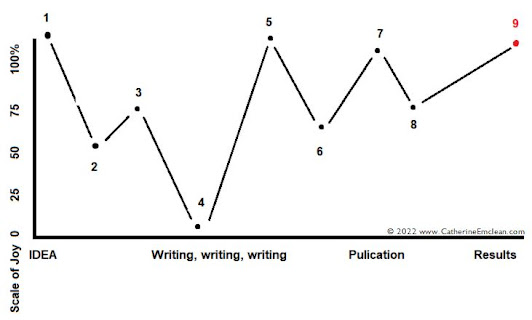
 Being a writer, I bet you've experienced ups and downs, the surges and lulls of the struggle to get a story onto a page. So often a writer blasts off like a rocket ship with an idea and then the engine quits. The idea plummets to earth, the reality-check that what seemed so grand has exploded into nothing worthwhile. The pattern may look like this: 


1. This is the "ah-ha moment," the manic high, the stupendous exuberance of the idea's arrival. The thrill of "what if" that sets a writer off to scribble down the bones or a scene of the idea. But this "ah-ah moment" of conception can also be a character coming forward and intriguing the writer into telling their story. Such an idea is the most beautiful of wild roses, but— 

2. The rose has thorns. The first thorn-prick is a reality check—  there are problems with the idea, the character, the plot. And so the joy fades.

3. But the rose's scent lingers. That idea has the writer pausing, reflecting, and thinking that the idea isn't as bad as first feared. Hope renews with possible fixes, new information, and so on.

4. However, the fix nets another jab of a thorn—more problems, seemingly unsolvable. Then come questions without answers. The writer feels stuck in a depressing quagmire.

5. But the recalled, heady, first-scent of the rose, the idea itself, beckons anew, whispering of a promise that must be written. The stick-to-it-ness of being a writer kicks in, and a renewed sense of can do, must do, nets a draft to be shared and feedback sought.

6. With that feedback, the red-pen notations, the scowls and blank faces of readers, additional thorns sink deep and draws blood that the work is doomed. The pessimist within the writer whispers "you can't write this."

7. And yet, the realization dawns— the work needs a few Band Aids. A tweak here. A restating there. Another realization—the work is good enough, not perfect but worth shipping out to beta readers and keeping one's fingers crossed.

8. The beta readers seem to take forever to return their feedback. It's good feedback. Now the book goes out to a professional editor or agent.

9. If all has gone well, the book becomes a bouquet of roses, published, earning five-star reviews, being talked about, entertaining the populous, or affecting their lives.

Writing often seems like a topsy-turvy endeavor. One that takes perseverance.


So, where on the graph are you now with your current WIP (Work In Progress)?

# # #


Tuesday, February 1, 2022


Here's a little quiz dealing with the language of writing and being a writer. Answers appear at the end. 


When proofreading, AWK stands for

When proofreading, POV stands for

When proofreading, LS stands for

Widows and Orphans are

deus ex machina is

Beats are 

C-E stands for

Dénouement is

Grawlix is  

The Black Moment is


Now try your hand at these True of False statements:

1. Dialogue has 13 functions (or more)

2. Internalizations are not dialogue

3. Exposition is telling not showing

4. A plot and theme go hand in hand

5. A flashback is a short look at what happened in the backstory and is presented in the now of the story

6. A vignette is a short story


ANSWERS:

When proofreading, AWK stands for Awkward. That is, the text did not make sense, forcing the reader to stop reading and enjoying the story to reread and puzzle out — and guess — what the writer meant. Another type of AWK is where sentences were joined together (by "and" or semicolons or colons) to the point of the reader being uncertain what was happening or going on or who was doing what to whom.

POV stands for Point of View

When proofreading, LS stands for Long Sentence. An average sentence is considered 20 words. Any sentence exceeding 30 words should be looked at for being awkward (AWK) or a run-on or a convoluted sentence.

Widows are one line from the previous page stranded at the top of the next page. Orphans are one to three words stranded on one line at the end of a paragraph (often changing one "big" word to a simpler "smaller" word will free up that line for better use.

Deus ex machina is an unexpected character who appears in the climax to solve the story and save the hero and heroine. Reader don't like it when someone other than the Protagonist solves the story problem or is resued.

Beats are bits of stage business or actions interspersed throughout a scene, often involving physical gestures, like pouring a glass of wine or walking into or out of a room.

C-E stands for Cause and Effect (often C-E is skewed or elements of the logical straightforward sequence of events or actions are missing).

Dénouement is the final resolution of the main story's problem.

 Grawlix is that bunch of swearing symbols: "£$%*>#!

The Black Moment is when the Protagonist faces off with the Antagonist in the story's climax.


True of False:

1. Dialogue has 13 functions (or more) TRUE

2. Internalizations are not dialogue FALSE - internalizations are dialogue that is not spoken out loud

3. Exposition is telling not showing TRUE

4. A plot and theme go hand in hand TRUE

5. A flashback is a short look at what happened in the backstory and is presented in the now of the story FALSE - a flashback is a long look back, a full-blown scene).

6. A vignette is a short story FALSE (Vignettes are "slices of life").


How did you do? Did you cheat and look at the answers while doing the quiz?


***Feel free to share this quiz with other writers.***

# # # 


Saturday, January 1, 2022

2022 - January - Begetting Quality

  This year we're back to first-of-the month posts, this year topics are about writing well and telling a story well. 


Writing does not beget good writing, it begets repetition of the same-old principals of setting words into sentences that were taught in school. 

In order to write quality stories worth a reader's interest, time, and money, a writer needs to learn and then train their mind to write with techniques of the successful, highly paid, multi-published.

It's the difference between learning to swim and making the Olympic team in swimming.

That's why I tell new writers to stop writing and learn craft. Craft enhances talent and liberates creativity. And here's the catch — by learning craft, a writer must practice what they're learning and thus bring to the writing a whole new aspect of workmanship and mastery of word images.

Other benefits follow, like far less rewriting, far less revising, and far less errors of all kinds from the big picture of plot to the minuscule of line edits done word by word.

If you're truly interested in writing well and telling a story well, then take a time out to learn. Start with books on craft, not an Internet blog post or two of a few hundred words, but books that cover a topic-subject in tens of thousands of words. Then practice that craft subject in a short form—  a short story or a scene—  until it comes naturally. Those will not be wasted words. Those will be better words, better scenes, better stories.

So where should a writer start this learning curve? Start by learning what story is. And I will recommend the following books that can teach this:

A STORY IS A PROMISE by Bill Johnson
This book is filled with, as the subtitle says: "Good things to know before you write that screenplay, novel, or play." And never forget, verbal stories, epic poem-stories, and plays came long before novels.

HOW TO TELL A STORY—THE SECRETS OF WRITING CAPTIVATING TALES by Peter Rubie and Gary Provost
This book does hold the secrets of writing captivating tales.
WRITING THE SHORT STORY—A HANDS-ON PROGRAM by Jack M. Bickham 
This book takes a writer step-by-step through the Developed Short Story. Here's the catch: the only difference between the Developed Short Story and a Novel is length and scope. Learn to write the Developed Short Story and the novel is oh so much easier to do.

SAVE THE CAT by Blake Snyder 
A screenwriters bible, but again, plays came before novels. This book's how-to's give insight and practical advice on story and writing a story.

You don't have to buy the books. You can usually get them through the Library Loan system. 

It's the New Year and resolutions and goals often are set — or at least thought about. Isn't it time you made a commitment to not just writing the same-old way but writing well and telling a story well?

****Stop back the first of February for the next posting to this blog.   — Catherine E. McLean, Author, Writing Instructor, Workshop Speaker

Connect with me at


# # #  

Friday, October 1, 2021

2021 - October through December — Fears Worse Than Death


This year's posts have all dealt with "lists" (also known as Cheat Sheets) that help a writer recall necessary elements before (or after) writing that make for a story worth telling and selling. Such Cheat Sheets are the backbone of a producing writer's Project Bible. 


Fears Worse Than Death 


One of the key elements to collect and put on a Master Character Worksheet or Questionnaire and to ask only of your main characters is: What is your fear worse than death?

That's right — 

There are things far worse then death or dying. Among them are fears and phobias. 

Often a fear or a phobia is the Protagonist's or Antagonist's Achilles' heel, their weakness, their vulnerability, which will play out in the story in some way, often in a major or catastrophic way.

Such a fear or phobia makes the character more human or adds a quirk to their personality. For instance, Indiana Jones's fear of snakes. My own fear is of wasps and hornets. I've been stung so many times over the years that I am now allergic to their stings. As a result, should I hear a buzz, I about panic looking for the culprit to kill it before it stings me.

It's important that a writer avoid plastering just any fear or phobia onto a character. The fear or phobia has to be part and parcel of the character's character because their fear or phobia resulted from a "cause." That is, something happened in the Protagonist's or Antagonist's past that created that particular fear and that fear, in turn, affects how the character judges and reacts or tries to avoid dealing with the fear or phobia they have acquired.

These fears-phobias fall into three groups: debilitating, life-threatening, and extremely humiliating. The result it that the character (or a person) will do just about anything to avoid facing that fear. One example is the fear of public speaking, which to most seem to result in the ultimate of humiliations.

Of course, often the character doesn't realize what affect that original fear-inducing incident had on them until "The Wise One" or "The Voice of Reason" type of character in the story points it out to them—or the Antagonist uses that fear or phobia against the Protagonist (or vice versa). What Lex Luther villain doesn't enjoy jabbing a little kryptonite into Superman?

Over the years, and from many different sources, I've put together my own extensive list of "Fears Worse Than death" (which includes phobias) that people have. You can start your own list by checking out: https://www.therecoveryvillage.com/mental-health/phobias/related/list-of-phobias/

Such a list should go into your personal, master copy of your Story Project Bible.

* * * 


October 9, 2021  — I will be giving two IN-PERSON writing workshops in Erie PA at the WRITER'S ROAD TRIP #9. This is the 9th year for the event hosted by Area 1 Pennwriters, part of Pennwriters, Inc. 


REGISTRATION AND INFORMATION
CAN BE FOUND  HERE


OR AT 

https://pennwriters.org/content.aspx?page_id=4002&club_id=522048&item_id=1516903


Monday, July 5, 2021

2021 - July through September - Why They Kill List

    This year's posts will deal with "lists" (also known as Cheat Sheets) that help a writer recall necessary elements before writing (or after) that make for a marketable story, a story worth telling and selling. Such Cheat Sheets are the backbone of a producing writer's Project Bible. 


The "Why They Kill" List

Be they hero or villain, Protagonist or Antagonist, have you every thought about why they would kill or why they might loath killing? 

Disregarding them being caught red-handed or cornered with no way out of the predicament they've gotten themselves into, below are some reasons to ill that might help flesh out or better understand your Antagonist or Protagonist. They would kill for:

MONEY 

ENJOYMENT (sadistic or cold-blooded)

REVENGE 

SEX (jealousy)

JEALOUSY OR ENVY (over personal possessions, social or job status, etc.)

PERVERTED ACTS 

DRUGS

CULTISM

TERRORISTS

CHILDREN ARE A BURDEN

INADEQUACY AS A PARENT

HATE

BECAUSE THEY ARE DELUSIONAL, MENTALLY ILL, OR INSANE

BECAUSE THEY ARE ASSASSINS 

BECAUSE THEY ARE ADDICTED TO BLOODLETTING OR HOOKED ON KILLING

It should be noted that men far outnumber women when it comes to the above. And speaking of women killers, did you know that 50% of women shoot their victims while 3% bludgeon, stab, torture, suffocate, neglect, or drown victims? And then there are the 29% of woman who employ a combination of the above.

One last thing, there is little difference between terrorists and hit men (assassins), but there are types— 

The Enforcer who has a cold-blooded mentality

Those where murder is an art to them

Those that are loyal only to the person who pays them

They are vicious psychopaths— having aggressive, perverted, criminal, or amoral behavior

They are sociopaths— having a personality disorder marked by aggressive, antisocial behavior

So, under what circumstances would your Protagonist kill someone?

Under what circumstance would your Antagonist kill someone?

********************

Next posting October 1, 2021